
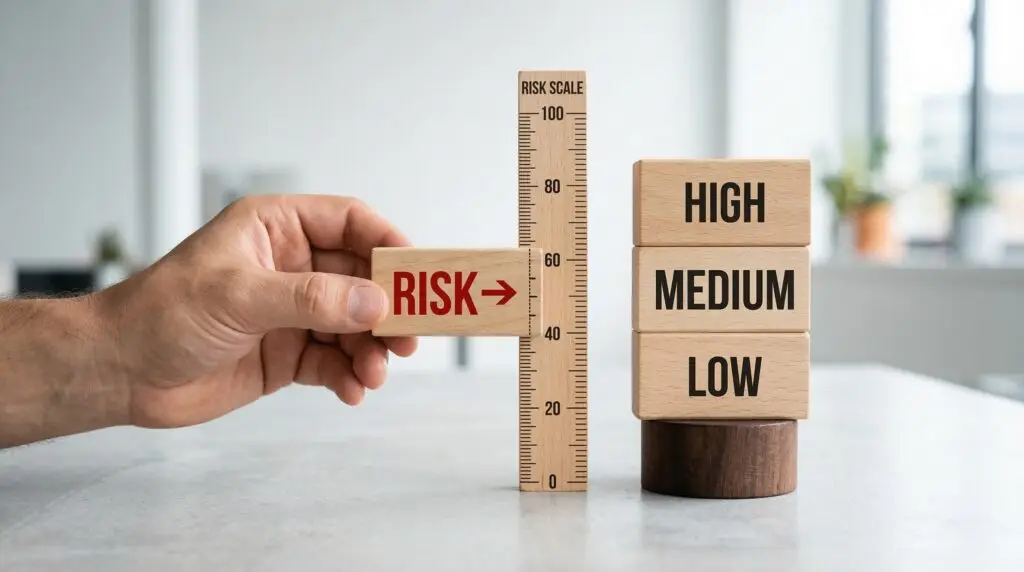
When your calibration certificate lists measurement uncertainty, it reveals something critical about your results that could be quietly affecting every quality decision you make.
If you’ve ever received a calibration certificate, you’ve likely noticed a number or range labeled “measurement uncertainty” and wondered what it actually means for your work. It’s not just a technicality buried in fine print. It directly affects how you interpret your results and make quality decisions. Understanding it could change how you approach every measurement in your process. Here’s what you need to know.
Understanding uncertainty isn’t optional. It directly shapes how confidently you can trust your measurements and the decisions built on them.
What Measurement Uncertainty Actually Means
Measurement uncertainty is a quantified range that expresses how much a measured value could reasonably deviate from the true value. It’s not a flaw in your equipment or a sign of poor calibration. That’s one of the most common misconceptions quality professionals encounter.
Understanding its measurement significance helps you interpret results more accurately and make better decisions.
In practical applications, uncertainty tells you the boundaries within which the true value likely falls. Industry standards like ISO/IEC 17025 require laboratories to calculate and report this range so you can assess uncertainty implications before accepting or rejecting a measurement result.
Without this context, you’re making decisions based on incomplete information. Think of uncertainty as essential data, not a warning. It’s what makes your calibration certificate genuinely useful.
Measurement Uncertainty vs. Error: What’s the Difference?
Although they’re often used interchangeably, error and uncertainty mean very different things in metrology. Error is the difference between your measured value and the true value. It’s a specific number with error significance clarification built in once you identify it.
Uncertainty, however, acknowledges that you can never know the true value exactly, making uncertainty impact assessment an ongoing part of every measurement process.
Think of it this way: error is what went wrong, while uncertainty is what could vary. Measurement variability implications affect every reading you take, regardless of how careful you are.
Precision reliability examination reveals that even high-quality instruments carry some uncertainty range. Understanding measurement context importance helps you interpret both concepts correctly, because ignoring either one leads to poor decisions about whether your equipment actually meets specification.
The Five Sources of Measurement Uncertainty in Calibration
When you trace measurement uncertainty back to its roots, five core sources emerge that affect nearly every calibration process.
First, instrument limitations introduce inherent inaccuracies tied to resolution and drift.
Second, environmental factors like temperature, humidity, and vibration directly shift readings during measurement conditions.
Third, calibration techniques vary in rigor and execution, meaning procedural choices influence your final uncertainty values.
Fourth, human error affects everything from equipment handling to data recording, especially under time pressure.
Fifth, the reference standards you use carry their own uncertainty, which transfers directly into your results. This is why NIST traceability matters — it establishes an unbroken chain of reference back to national standards, bounding the uncertainty your lab inherits from its reference equipment.
Understanding these five sources won’t eliminate uncertainty, but it’ll help you identify where it originates, how to control it, and why your calibration certificate reflects values that account for all of them together.
How Measurement Uncertainty Is Calculated and Expressed
You’ll generally see three key elements reported:
- The measured value — what the instrument read
- The expanded uncertainty — the coverage interval around that value
- The coverage factor (k) — usually k=2, defining confidence level
The Guide to the Expression of Uncertainty in Measurement (GUM), published by the Bureau International des Poids et Mesures, is the internationally recognized framework labs use to calculate and document these values. Reporting best practices demand that calibration process variations get accounted for before that final number appears on your certificate.
What ISO 17025 Accreditation Tells You About Uncertainty Reporting
ISO/IEC 17025 accreditation isn’t just a credential a lab hangs on its wall. It’s a signal that the lab meets internationally recognized requirements for competence, including how it handles measurement uncertainty.
These ISO standards require accredited labs to identify, calculate, and report uncertainty as part of their calibration practices. That’s a core reporting requirement, not an optional add-on.
When you receive a certificate from an accredited lab, you’re benefiting from built-in quality assurance. The lab’s methods have been independently assessed and validated. You’re not just trusting the lab’s word. You’re relying on a verified process.
If a certificate lacks uncertainty information, that’s worth questioning. Accreditation benefits you precisely because it enforces the transparency and rigor your quality decisions depend on.
Coverage Factor, Confidence Level, and Expanded Uncertainty Explained
Three terms appear on almost every accredited calibration certificate: coverage factor, confidence level, and expanded uncertainty. Understanding how they connect changes how you read those numbers.
Coverage factor applications typically use k=2, which stretches the standard uncertainty to capture 95% of possible measurement outcomes. That’s the confidence level importance in practice. It tells you how statistically reliable the reported range actually is.
Expanded uncertainty examples help ground this concept:
- A pressure gauge reads ±0.05 psi at k=2, meaning 95% confidence the true value falls within that range.
- Raising k to 3 pushes confidence to 99.7%, widening the interval.
- Tighter expanded uncertainty signals better-controlled lab conditions.
These real world implications matter because uncertainty in practice directly affects whether your parts pass or fail acceptance criteria.
How to Use Measurement Uncertainty in Acceptance Decisions
Most quality professionals treat a calibration result as a simple pass or fail, but measurement uncertainty changes that calculation entirely.
When you’re verifying compliance, you can’t ignore the uncertainty range surrounding your measurement result. If a reading lands close to your acceptance criteria boundary, the actual value could fall on either side of that decision threshold.
You have two primary approaches: guard banding, which tightens your decision thresholds by the uncertainty amount, or risk assessment, which evaluates whether the uncertainty level is acceptable for your application. The American Society for Quality (ASQ) offers additional guidance on measurement system analysis for quality professionals navigating these decisions.
Your choice depends on the consequences of a wrong decision. For compliance verification, higher measurement precision reduces uncertainty and gives you more confidence in borderline results.
Treating uncertainty as irrelevant doesn’t eliminate risk. It just means you’re accepting it unknowingly.
What Happens When Measurement Uncertainty Is Ignored?
When you ignore measurement uncertainty, you’re not eliminating risk. You’re making uninformed decisions while assuming your measurements are exact.
The consequences ripple through every layer of your operation, creating decision making challenges and regulatory compliance issues that compound over time.
Without accounting for uncertainty, you’ll face:
- Quality control failures — borderline parts get accepted or rejected without understanding the actual measurement risk, sending defective products to customers.
- Risk assessment implications — your risk models become fiction, built on false precision that collapses under auditor scrutiny.
- Regulatory compliance issues — accreditation bodies and standards like ISO/IEC 17025 require uncertainty reporting, meaning gaps expose you during audits.
Treating measurements as absolute truths doesn’t make them accurate. It just makes your mistakes invisible until they become expensive. When your team relies on electronic calibration or mechanical calibration services, the lab’s uncertainty reporting practices directly determine how much you can trust every measurement downstream.
Why Don’t All Calibration Certificates Report Uncertainty the Same Way?
Once you understand what’s at stake when uncertainty gets ignored, the next question becomes practical: why do calibration certificates look so different from one another?
Calibration variations exist because no single global standard governs certificate formats across every industry. Reporting standards like ISO/IEC 17025 require uncertainty disclosure, but they don’t dictate exact layout or terminology. That flexibility creates inconsistency.
Industry practices also differ. Aerospace, medical, and manufacturing sectors each carry unique uncertainty definitions shaped by their regulatory environments. Some labs express uncertainty at k=2, others at k=3, and some don’t explain their coverage factor at all.
When you’re reviewing a certificate, check whether the lab is accredited, how they define their terms, and what confidence level their uncertainty statement reflects. Those details determine whether the number means anything useful to you. For organizations that need calibration performed at their facility, on-site calibration services can minimize equipment downtime while still delivering properly documented uncertainty reporting.
Get Calibration Certificates You Can Actually Trust — from EML Calibration
Measurement uncertainty reporting isn’t something every calibration lab handles with the same rigor. At EML Calibration, it’s built into every certificate we issue. As an ISO/IEC 17025:2017 accredited laboratory with NIST-traceable standards and more than 25 years of experience, EML provides the transparent, technically sound documentation your quality team needs to make confident decisions. Whether you’re managing acceptance thresholds, preparing for an audit, or simply trying to understand what your certificate is telling you, EML has the expertise to support you. Request a quote today and put measurement uncertainty to work for you, not against you.