Signal generator calibration requires verifying critical specifications like frequency accuracy, amplitude stability, and spectral purity against certified reference standards. You’ll need proper environmental conditions, adequate warm-up time, and specialized test equipment, including spectrum analyzers and power meters. To guarantee measurement reliability, focus on harmonic distortion, phase noise, and spur-free dynamic range. Professional documentation maintains traceability, while regular maintenance prevents drift. Mastering these fundamentals opens the door to advanced techniques that maximize your instrument’s precision capabilities.
Understanding the Basics of Signal Generators
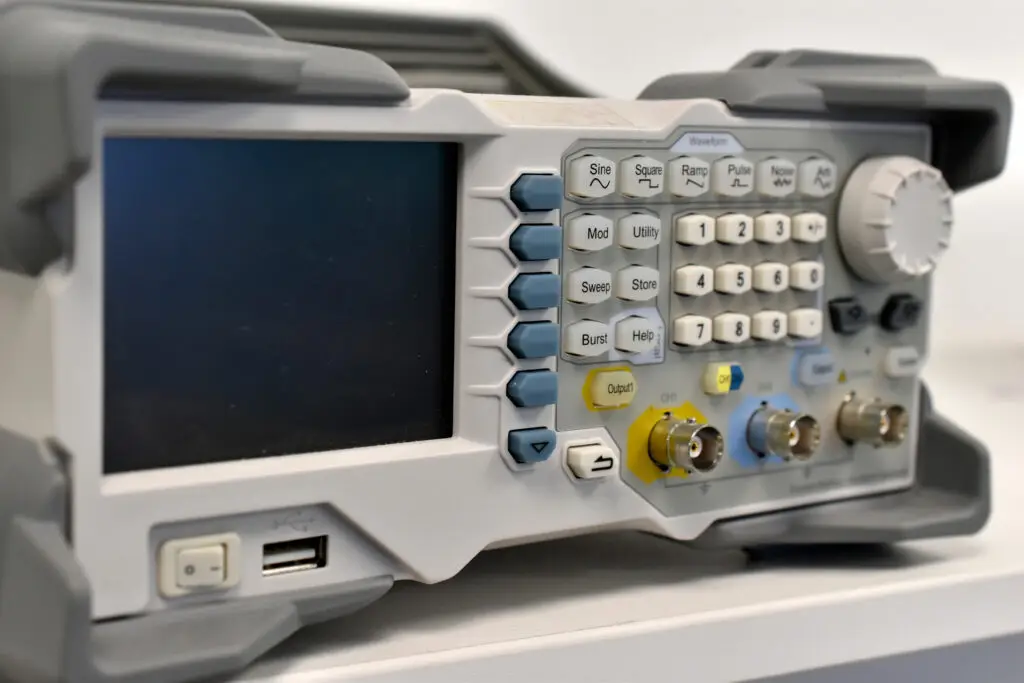
While signal generators might appear to be simple electronic boxes, they are the foundation for countless precision measurements and testing applications across industries. These instruments create precise waveforms for testing receivers, amplifiers, and communication systems in telecommunications, aerospace, and manufacturing environments.
Understanding key performance metrics is vital for effective operation. Frequency accuracy, amplitude stability, and spectral purity directly impact measurement reliability. When maintaining these instruments, you’ll encounter calibration terminology like uncertainty, traceability, and drift.
Regulatory standards such as ISO/IEC 17025 govern calibration procedures, ensuring consistent results. When issues arise, troubleshooting techniques focus on checking reference oscillators, output amplifiers, and internal connections. Proper comprehension of these fundamentals enables you to maximize your signal generator’s performance and maintain measurement confidence across critical signal generator applications.
Critical Specifications for Calibration
When calibrating signal generators, you must focus on three fundamental specifications determining measurement accuracy: frequency precision, amplitude stability, and phase noise performance.
Frequency stability directly impacts your instrument’s ability to maintain consistent output over time and temperature variations. You must verify this specification against certified reference standards to ascertain reliable measurements.
Harmonic distortion affects signal purity and can compromise test results in sensitive applications. To preserve signal integrity, monitor total harmonic distortion levels during calibration.
Spur-free dynamic range determines your generator’s ability to produce clean signals without unwanted spurious components. Phase noise calibration safeguards proper spectral purity, while output impedance verification guarantees adequate power transfer and prevents reflections that could affect measurement accuracy in your test setups.
Impact of Calibration on Signal Quality
How does proper calibration translate into measurable improvements in your signal generator’s output quality? When you maintain precise calibration standards, you’ll see dramatic boosts across multiple performance parameters.
Amplitude stability is enhanced, reducing output variations that could compromise your test results. Calibration directly minimizes spurious emissions, ensuring cleaner spectral output without unwanted frequency components interfering with your measurements.
Through regular calibration, phase noise characteristics become more predictable and controlled, which is critical for applications requiring stable frequency references. Your modulation accuracy increases tremendously, delivering precise AM, FM, and digital modulation parameters that match your specifications exactly.
Proper calibration decreases harmonic distortion levels, producing purer sinusoidal outputs. These improvements translate into more reliable test data, reduced measurement uncertainty, and heightened confidence in your signal generator’s performance across all operating conditions.
Prerequisites for Effective Calibration
Achieving these performance improvements requires careful preparation before beginning any calibration procedure. You must establish proper environmental conditions, maintain temperature stability within ±2°C, and maintain humidity levels between 45-75% RH.
Your signal generator must undergo adequate stabilization requirements, typically 30-60 minutes of warm-up time, depending on the model.
Necessary standards include certified reference sources with at least four times better accuracy than your device under test. Equipment selection involves choosing appropriate power meters, frequency counters, and spectrum analyzers that match your calibration scope.
Don’t overlook technician expertise—qualified personnel must understand both the calibration procedures and your specific signal generator’s characteristics. Proper documentation, calibration software, and backup power sources complete your preparation checklist for successful calibration outcomes.
Detailed Calibration Process Steps
Once your preparation is complete, you’ll execute the calibration process through four distinct phases that build upon each other systematically.
First, you’ll establish reference source selection by connecting your primary frequency standard and power meter to create measurement baselines. Next, test equipment preparation involves configuring measurement ranges and verifying connection integrity between instruments.
The third phase requires operator qualification verification, guaranteeing technicians possess current certifications and follow documented procedures precisely. You’ll conduct environmental monitoring throughout each step to track temperature, humidity, and electromagnetic interference levels.
Finally, you’ll analyze measurement uncertainty by calculating combined uncertainties from all sources—reference standards, environmental conditions, and measurement repeatability. This thorough approach assures your signal generator meets specified accuracy requirements while maintaining full traceability to national standards.
Advanced Techniques for Enhanced Calibration
Beyond standard calibration procedures, you’ll encounter specialized techniques that push measurement precision to its limits and address complex signal characteristics. Phase noise calibration requires sophisticated spectrum analyzers and cross-correlation methods to accurately measure your generator’s spectral purity. You’ll need specialized equipment for pulse modulation calibration, examining rise times, fall times, and duty cycle accuracy under various loading conditions.
Digital modulation verification demands vector signal analyzers to assess constellation diagrams, error vector magnitude, and symbol timing precision. Modern instruments offer instrument self-calibration routines that automatically adjust internal references, though you shouldn’t rely solely on these automated processes.
Advanced waveshape analysis involves examining signal integrity across multiple domains—time, frequency, and statistical—ensuring your generator meets stringent specifications for critical applications requiring exceptional measurement accuracy.
Ensuring Documentation and Traceability
Proper documentation transforms your calibration efforts from isolated technical procedures into verifiable, legally defensible measurement assurance. You’ll need detailed calibration certificate requirements that detail measurement results, environmental conditions, and equipment specifications. Your uncertainty calculation must include all contributing factors—reference standards, environmental variations, and measurement repeatability—expressed with appropriate confidence levels.
NIST traceability documentation establishes the unbroken chain connecting your signal generator’s calibration to national measurement standards. You should maintain detailed records showing each calibration step’s reference to higher-level standards. Calibration schedule considerations depend on equipment drift characteristics, usage patterns, and application criticality. Implement calibration record retention policies spanning at least your equipment’s operational lifetime, ensuring regulatory compliance and effectively supporting quality audits.
Routine Maintenance for Optimal Performance
How frequently should you confirm your signal generator’s performance between formal calibrations? You should establish a routine maintenance schedule based on your usage patterns and critical application requirements. Performance verification tests should occur monthly for high-use instruments, checking frequency accuracy and amplitude stability against known references.
Connector inspection prevents signal degradation—examine all RF connectors for wear, corrosion, or damage that affects measurement integrity. Clean connectors using appropriate solvents and inspect center conductors for proper positioning.
Battery replacement becomes critical for portable units, as weak batteries compromise accuracy. Monitor battery voltage regularly and replace it before performance declines.
Environmental monitoring guarantees stable operating conditions. Store your signal generator in controlled temperature and humidity environments, protecting it from dust and vibration affecting internal components and calibration drift.
Choosing Professional Calibration Services
When should you consider outsourcing your signal generator calibration instead of handling it internally? You’ll need professional services when your equipment requires specialized standards beyond your laboratory’s capabilities or when industry regulations demand accredited calibration certificates.
Start by researching providers with ISO/IEC 17025 accreditation and NIST traceability. Compare on-site service costs against shipping expenses and downtime risks.
Review accreditation requirements specific to your industry—aerospace and medical device manufacturers often face stricter standards than general electronics companies.
Evaluate maintenance intervals to determine cost-effectiveness. Frequent calibrations may justify in-house capabilities, while annual requirements often favor outsourcing. Check customer reviews and request references from similar industries.
Consider providers offering laboratory and mobile services for flexibility during critical project phases.
Signal Generator Precision: The Foundation of Accurate Electronic Testing
Signal generators are the backbone of electronic testing and system development, providing precise reference signals essential for calibrating other instruments, validating circuit performance, and conducting accurate measurements across countless applications. Regular professional calibration ensures that frequency accuracy, amplitude precision, and modulation quality remain within critical specifications, directly impacting the reliability of all downstream testing and measurement activities.
By implementing a strategic calibration program with proper documentation and adherence to industry standards, engineers and technicians can maintain confidence in their signal sources and avoid cascading errors that result from inaccurate reference signals. The precision of your signal generators directly influences the quality and reliability of every test they support—don’t compromise your measurement infrastructure with inadequately calibrated equipment.
Contact EML Calibration today to leverage their specialized expertise in signal generator calibration, backed by ISO/IEC 17025:2017 accreditation and NIST traceable standards. With 25 years of proven experience and flexible on-site or laboratory calibration options, EML Calibration ensures your signal generators deliver the precision and stability your critical testing applications demand.