When your CMM starts producing questionable measurements, you need answers fast. Understanding calibration and performance verification isn’t optional—it’s what separates reliable data from costly production mistakes.
You’ll need to know what’s actually being measured during calibration, why failures happen, and which standards apply to your specific operation. There’s more to this process than most operators realize, and the details matter more than you’d think.
What Does CMM Calibration Actually Measure?
When you send a CMM in for calibration, you’re not just getting a stamp of approval—you’re getting a detailed map of how the machine actually performs across its entire working volume.
Calibration quantifies real errors—linear displacement, straightness, squareness, and rotational deviations across all three axes. These measurements reveal how the machine’s actual motion compares to its commanded motion.
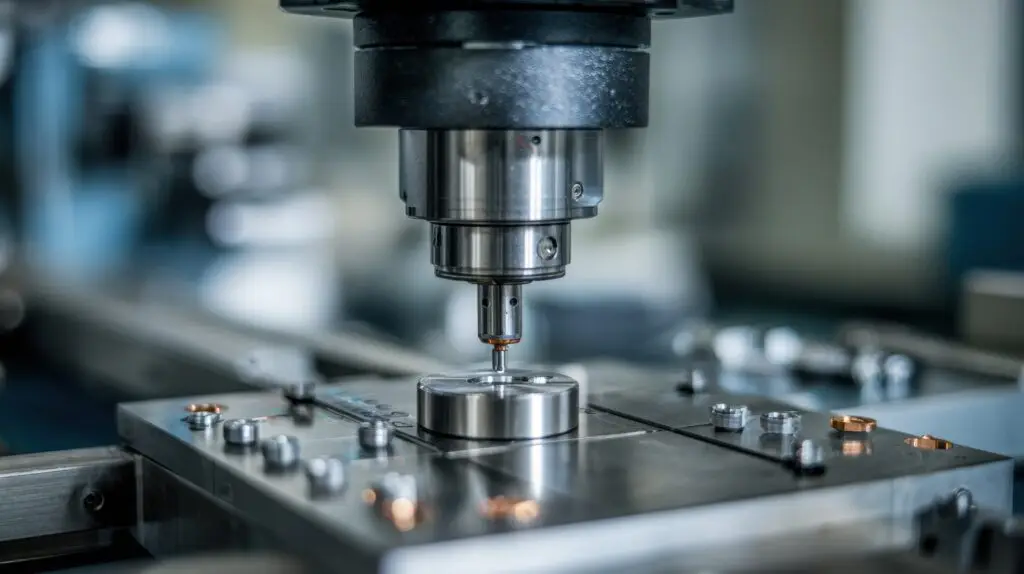
Probe qualification adds another layer, capturing tip geometry errors and stylus bending characteristics.
Software compensation then uses this data to correct for known errors during measurement.
What you’re ultimately documenting is volumetric accuracy—the machine’s ability to correctly report a point’s location anywhere within its working envelope.
Without this data, you’re operating on assumption rather than verified performance.
What Causes CMM Verification Failures: Thermal Drift, Probe Wear, and Geometry Errors
Understanding what can go wrong is just as important as knowing what calibration measures. Three primary failure sources account for most CMM verification issues: thermal drift, probe wear, and geometry errors.
Thermal drift occurs when temperature fluctuations cause machine components to expand or contract, altering measurements beyond acceptable tolerances. You’ll typically see this in shops without stable climate control.
Probe wear gradually degrades stylus tips, introducing repeatability errors that compound across multiple measurements. If you’re running high-volume inspection, you need to check probe condition regularly.
Geometry errors involve misalignments in the machine’s axes, often developing from vibration, improper leveling, or mechanical wear over time.
These errors corrupt volumetric accuracy across the entire measurement envelope, making them particularly difficult to detect without formal verification testing.
ASME B89.4.1 vs. ISO 10360: Which CMM Verification Standard Applies to You?
Two major standards govern CMM verification—ASME B89.4.1 and ISO 10360—and knowing which one applies to you depends largely on your industry, customer requirements, and geographic market.
If you’re operating in the United States and serving aerospace or defense customers, you’ll likely follow ASME B89.4.1. If you’re supplying European manufacturers or working within a globally oriented supply chain, ISO 10360 is probably your requirement.
Both standards assess volumetric performance and probe qualification, but they differ in test methods, acceptance criteria, and terminology.
ISO 10360 uses maximum permissible error (MPE) specifications, while ASME B89.4.1 emphasizes uncertainty-based reporting.
Your CMM’s manufacturer documentation typically references one or both standards, so review your customer contracts and quality system requirements before scheduling verification to confirm which standard you actually need.
When Does Your CMM Need Interim Checks vs. Full Verification?
Deciding between interim checks and full verification comes down to risk, usage patterns, and what your quality system actually requires.
If your CMM runs high-volume production or measures safety-critical parts, you need interim checks between full verifications. These shorter checks confirm your machine hasn’t drifted since its last calibration without repeating the entire verification process.
Full verification follows ASME B89.4.1 or ISO 10360 protocols and establishes your CMM’s baseline performance across its entire work volume.
You’ll typically need this annually, after a crash or repair, following a facility move, or when your quality system mandates it.
Interim checks use reference artifacts to detect sudden changes. If results fall outside tolerance, you stop production and investigate before running a full verification.
Protect Your CMM Investment with EML Calibration Services
When it comes to your CMM’s reliability, you can’t afford to cut corners. You’ve learned what calibration actually measures, what causes verification failures, and which standards apply to your operation. Now it’s time to act on that knowledge. Schedule your interim checks, address thermal drift and probe wear proactively, and choose the verification standard that fits your workflow. Your measurement accuracy directly impacts your product quality—don’t let it slip.
EML Calibration delivers ISO/IEC 17025:2017 accredited CMM verification services in accordance with ASME B89.4.1 and ISO 10360 standards, backed by over 25 years of coordinate measurement expertise. We provide comprehensive volumetric accuracy testing, probe qualification, and performance documentation using NIST traceable artifacts.
Contact us today to schedule your CMM verification and ensure your measurement systems maintain the precision your quality programs require.