Temperature and Humidity Calibration: Keeping Environmental Monitoring Accurate
A temperature probe that reads two degrees high looks exactly like one that reads true. So does a humidity sensor that has slowly drifted for a year. Temperature and humidity calibration is how you find out which one you have. It compares your instrument against a known, NIST-traceable reference, records the difference, and tells you whether the reading can be trusted.
This guide is for quality managers, lab managers, facilities teams, and anyone responsible for a cold room, stability chamber, cleanroom, or production area where temperature and humidity are logged. You will learn how the common sensors work, how a calibration lab checks them, why they drift, and what to look for in a calibration partner.
Key takeaways
- Every temperature and humidity sensor drifts over time. Calibration measures how far, so you can correct it before it becomes an audit finding or a bad batch.
- Thermocouples, RTDs, and thermistors each suit different jobs and age differently.
- Humidity sensors are harder to calibrate than temperature sensors because they react to their recent history (hysteresis) and to temperature itself.
- A useful calibration certificate shows as-found and as-left readings, the measurement uncertainty, and an unbroken traceability chain to national standards.
- An ISO/IEC 17025:2017 accredited lab gives auditors independent proof that the calibration was done competently.
In this guide
- Why temperature and humidity calibration matters
- The sensors you are calibrating
- How temperature and humidity calibration works
- Common calibration challenges
- How to choose a calibration partner (checklist)
- Frequently asked questions
Why temperature and humidity calibration matters
Temperature and humidity readings decide real outcomes. They decide whether a vaccine is still usable, whether a drug passes stability testing, whether a food product is safe, and whether an electronics part was assembled in the right conditions. If the sensor is wrong, every decision built on it is wrong too.
The tricky part is that a drifting sensor gives no warning. The display still shows a clean number. The data logger still records a tidy graph. Only a comparison against a trusted reference reveals the gap.
Regulators and auditors know this, which is why most quality systems require it. FDA current good manufacturing practice rules for drug makers, for example, call for instruments and recording devices to be calibrated at suitable intervals under a written program (21 CFR 211.160). ISO 9001, ISO 13485, and GLP/GMP programs carry similar expectations. When an auditor pulls a temperature log, the first follow-up question is usually: when was this sensor last calibrated, and can you show me the certificate?
Calibration also protects you between audits. Catching a probe that has drifted 1.5 °C during a routine check costs far less than discovering it after a chamber full of product has been stored out of range.
The sensors you are calibrating
Most environmental monitoring relies on a handful of sensor types. Knowing which one you have helps you understand how it will age and how it should be calibrated.
Thermocouples
A thermocouple is two wires of different metals joined at one end. Heat that junction and it produces a tiny voltage that changes with temperature. Thermocouples are cheap, tough, and handle extreme heat, often well over 1,000 °C depending on type. The tradeoff is accuracy. They are less precise than other sensors and drift faster, especially after long stretches at high temperature. You will find them in ovens, furnaces, autoclaves, and heat-treating equipment.
RTDs (resistance temperature detectors)
An RTD measures temperature through the electrical resistance of a metal, usually platinum. The most common version, the Pt100, reads 100 ohms at 0 °C. RTDs are stable and accurate, which makes them the standard choice for pharmaceutical processes, stability chambers, and lab reference work. They cost more than thermocouples and are more sensitive to rough handling.
Thermistors
A thermistor is a small ceramic or semiconductor bead whose resistance changes sharply with temperature. That makes it very sensitive within a narrow range, roughly the range people and products live in. Thermistors are common in data loggers, refrigerators, freezers, and medical devices.
Digital temperature indicators
The display or logger the probe plugs into is part of the measurement too. A perfect probe connected to a drifting indicator still gives a wrong answer. Good practice is to calibrate the probe and indicator together as a system, or to calibrate each and document both.
Humidity sensors
- Capacitive sensors are the most common type. A thin polymer layer absorbs moisture from the air, which changes its electrical capacitance. They are used in most handheld meters, transmitters, and loggers.
- Resistive sensors work similarly but measure a change in resistance. They are often found in lower-cost devices.
- Chilled-mirror hygrometers cool a small mirror until dew forms, then measure that dew point directly. They are highly accurate and are often used as the reference standard in humidity calibration.
- Psychrometers compare a dry thermometer with one wrapped in a wet wick. The difference between them indicates humidity.
| Sensor | Best at | Watch out for | Typical uses |
|---|---|---|---|
| Thermocouple | Extreme heat, rugged settings | Lower accuracy, faster drift at high heat | Ovens, furnaces, autoclaves |
| RTD | Accuracy and long-term stability | Cost, fragility | Pharma processes, stability chambers |
| Thermistor | High sensitivity in a narrow range | Limited range | Data loggers, cold storage, medical devices |
| Capacitive humidity sensor | Everyday humidity monitoring | Hysteresis, contamination, drift | Transmitters, loggers, handheld meters |
| Chilled-mirror hygrometer | Highest humidity accuracy | Cost, upkeep | Reference standard, critical environments |
How temperature and humidity calibration works
The idea is simple. Put your sensor and a more accurate reference sensor in the same stable environment, read both, and record the difference. Repeat at several points across the range you actually use.
Temperature: bath and dry-block methods
- Liquid baths hold a fluid (water, oil, or alcohol, depending on the temperature) at a very steady temperature. The liquid surrounds the probe evenly, so baths give the most uniform conditions and the lowest uncertainty. They are the go-to method for high-accuracy RTD and thermistor work.
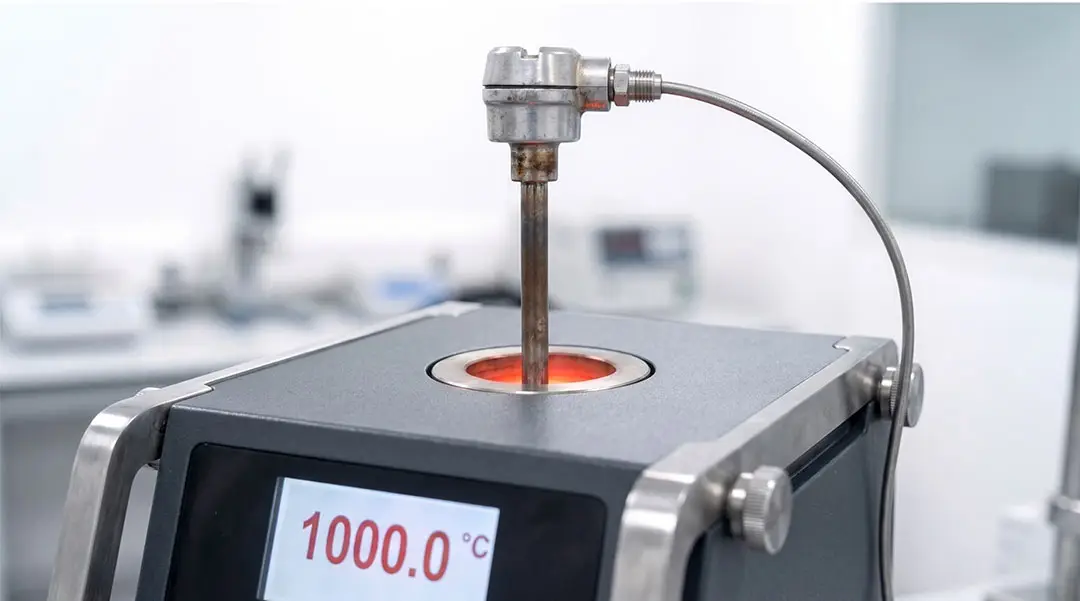
- Dry-block calibrators use a heated or cooled metal block with drilled wells for the probes. They are portable and fast, which makes them practical for on-site work. Results depend on a snug fit between probe and well, so the right insert matters.
Either way, the reference is a calibrated standard thermometer, often a precision platinum RTD, whose own accuracy is known and documented.
Humidity: chamber verification
Humidity calibration uses a chamber or generator that holds a set humidity and temperature steady. The sensor under test and a reference hygrometer, often a chilled-mirror unit, are read side by side. A good calibration checks several points, such as a low, middle, and high humidity value. It also checks in both directions, rising and falling, to expose hysteresis (more on that below). For a quick field check, sealed salt solutions that produce a known humidity are sometimes used, but they are slower and less flexible than a controlled chamber.
NIST traceability
Your reference standard was calibrated against a better standard, which was calibrated against a better one, and so on back to national standards maintained by the National Institute of Standards and Technology. NIST describes this as an unbroken chain of calibrations to specified reference standards. Each link in that chain has a stated uncertainty. NIST-traceable means you can show that chain on paper.
What a typical calibration looks like
- As-found check. The instrument is tested before any adjustment. This shows how far it had drifted, which matters if past readings need review.
- Adjustment, if needed. If the sensor is out of tolerance and adjustable, the technician corrects it.
- As-left check. The instrument is tested again to confirm it now reads correctly.
- Certificate. You receive documentation listing the test points, the as-found and as-left readings, the measurement uncertainty, the reference standards used, and their traceability.
If the as-found readings were out of tolerance, your quality team should assess what that sensor measured since its last good calibration. That is why the as-found data matters as much as the final pass.
Common temperature and humidity calibration challenges
Three problems cause most bad readings. None of them shows up on the display, which is exactly why scheduled calibration exists.
Sensor drift and contamination
All sensors drift. Thermocouple wire changes chemically after long exposure to heat. RTDs can shift after being dropped or vibrated. Humidity sensors age as their polymer layer is exposed to moisture, heat, and airborne chemicals such as cleaning agents, solvents, and disinfectant vapors. Texas Instruments, which makes humidity sensors, notes that a humidity sensor’s accuracy has three parts: its accuracy when it leaves the factory, hysteresis, and long-term drift (TI application brief). The factory number only describes day one.
What to do: calibrate on a regular interval, shorten it for sensors in harsh or chemically active spaces, and track as-found results over time. A sensor that drifts more each year is telling you it is near the end of its life.
Hysteresis in humidity sensors
Hysteresis means a humidity sensor’s reading depends partly on where it has just been. Coming down from a humid condition, it may read a little higher than it would going up from a dry one, even at the same true humidity. In plain terms, the sensor has a short memory. Hysteresis tends to grow when a sensor spends long periods at high humidity and high temperature (Process Sensing Technologies).
What to do: ask for calibration points taken in both rising and falling humidity, so the certificate shows how much hysteresis your sensor has. That figure belongs in your measurement uncertainty.
Thermal equilibrium
A sensor only reads the true temperature once it and everything around it have fully settled. Read too early and you capture a temperature that is still changing. This matters twice over for humidity, because relative humidity depends on temperature. In typical room conditions, a 1 °C difference between the sensor and the air can shift relative humidity by several percentage points.
What to do: allow proper soak time at each test point, keep probes fully immersed or seated in the right block insert, and keep the sensor and reference close together. Rushed calibrations are a common source of misleading certificates.
How to choose a temperature and humidity calibration partner
Use this checklist when comparing labs. Each item is something an auditor may ask you to show.
- ISO/IEC 17025:2017 accreditation that covers temperature and humidity in the lab’s scope, not just its general services
- NIST-traceable reference standards, with the traceability chain listed on the certificate
- As-found and as-left data at every test point, not just a pass/fail stamp
- Stated measurement uncertainty for each point
- Test points that match how you use the sensor, for example 2 °C to 8 °C for a vaccine fridge, not just room temperature
- Rising and falling humidity points so hysteresis is captured
- On-site option for chambers, cold rooms, and fixed sensors that cannot be removed
- Due-date tracking, so nothing expires unnoticed between audits
How EML Calibration helps
EML Calibration has provided NIST-traceable calibration from its Nashville lab since 1997. Our temperature and humidity work covers thermometers, RTDs, thermocouples, humidity instruments, and environmental chambers.
- Accredited documentation. We are accredited to ISO/IEC 17025:2017 by Perry Johnson Laboratory Accreditation. That means your certificates include as-found and as-left data plus stated uncertainty, ready for GLP/GMP, ISO 13485, and ISO 9001 audits.
- Calibration where your equipment lives. Chambers and cold rooms don’t travel well. Our mobile labs calibrate on site within 250 miles of Nashville, so sensors are checked in the environment they actually measure.
- Combined temperature and humidity testing. [EDITOR: confirm with EML before publishing. Describe the lab’s environmental chamber capability, the temperature range covered, the humidity range covered, and whether temperature and humidity are verified together in one session. Do not publish this bullet until those details are confirmed.]
- Repair in the same visit. When a sensor fails calibration, our technicians can often repair it in the same visit, so you avoid a second shipping cycle.
- No more spreadsheet tracking. Our asset management platform gives you 24/7 access to certificates and sends automatic alerts before anything comes due.
Frequently asked questions
What is temperature and humidity calibration?
Temperature and humidity calibration compares a sensor’s readings with a more accurate, NIST-traceable reference under controlled conditions. The lab records any difference at several test points, adjusts the sensor if needed, and issues a certificate. It confirms your environmental monitoring data can be trusted for quality decisions and audits.
How often should temperature and humidity sensors be calibrated?
Most organizations calibrate once a year, but the right interval depends on your quality system, the sensor type, and its environment. Sensors in harsh, hot, humid, or chemically active spaces may need shorter intervals. Review as-found results each cycle: steady drift is a sign to calibrate more often.
Why is humidity harder to calibrate than temperature?
Humidity sensors react to their recent history (hysteresis), absorb contaminants, and depend on temperature. A small temperature error creates a larger humidity error. That is why humidity calibration needs a stable chamber, careful soak times, and test points taken in both rising and falling humidity.
What is the difference between NIST-traceable and accredited calibration?
NIST-traceable means the reference standards connect back to national standards through an unbroken, documented chain. Accredited means an independent body, such as Perry Johnson Laboratory Accreditation, has verified the lab’s competence under ISO/IEC 17025:2017. Accredited calibrations are traceable, but traceable calibrations are not always accredited.
Can environmental chambers be calibrated on site?
Yes. Chambers, cold rooms, and fixed sensors are often best calibrated where they sit, because moving them is impractical and the goal is to verify the real operating environment. EML Calibration’s mobile labs perform on-site calibration within 250 miles of Nashville, Tennessee.
What happens if a sensor fails calibration?
The certificate shows the as-found readings, so you know how far off it was. The sensor can be adjusted, repaired, or replaced. Your quality team should then review data the sensor recorded since its last good calibration to judge whether any product or results were affected.
Keep your environmental data trustworthy
Every sensor drifts, and humidity sensors bring extra quirks like hysteresis and temperature sensitivity. Regular temperature and humidity calibration catches those changes early, documents them for your auditors, and keeps your monitoring data worth acting on. The essentials are simple: NIST-traceable standards, as-found and as-left data, stated uncertainty, and test points that reflect how you really use each sensor.
Need your probes, loggers, or chambers calibrated? Request a quote from EML Calibration with your instrument list, and tell us whether you need in-lab or on-site service.